
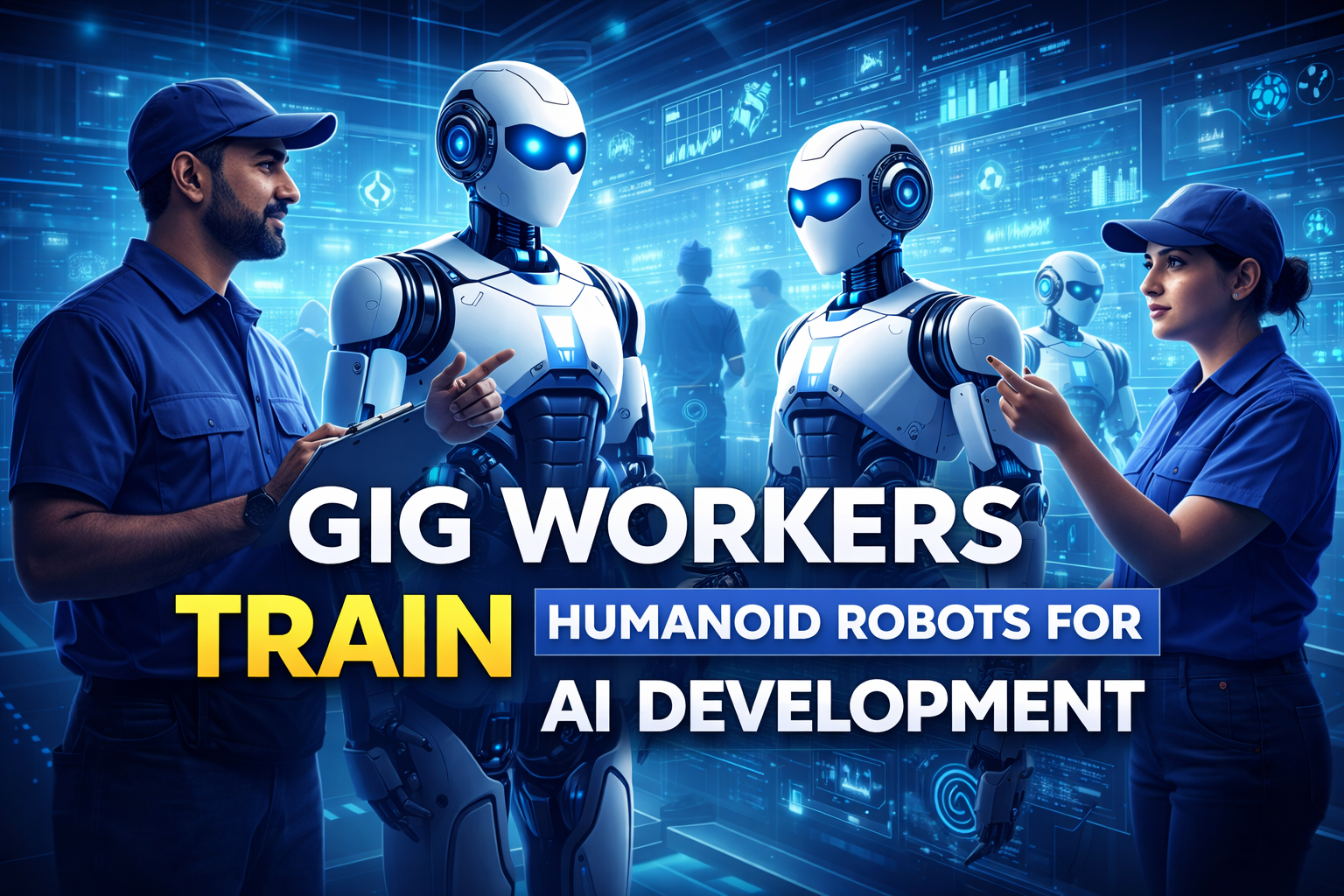
Somewhere in Bangalore, a freelancer wearing a VR headset is teaching a robot in California how to fold laundry. In Pune, another worker is labeling thousands of images showing a robotic arm the difference between a ripe tomato and an overripe one. Welcome to the newest corner of the gig economy — where humans train machines to replace humans.
This is not science fiction. Companies developing humanoid robots and physical AI systems are increasingly turning to distributed gig workers to train their machines. The model works like this: instead of hiring expensive in-house teams to demonstrate tasks or label training data, companies break down the work into micro-tasks and farm them out to remote workers worldwide.
Why Robots Still Need Human Teachers
Despite advances in AI, robots remain remarkably bad at tasks that humans find trivial. Picking up a cup, opening a door, navigating around furniture — these require what researchers call embodied intelligence, the kind of learning that comes from interacting with the physical world.
Training this intelligence requires massive amounts of demonstration data. Someone needs to show the robot how to perform a task, often thousands of times with slight variations. Traditionally, this meant hiring full-time operators or researchers to spend months in labs.
The gig model changes this equation entirely. By distributing the work across hundreds or thousands of remote workers — each contributing a few hours — companies can compress months of training into weeks. Workers use teleoperation systems (remote controls that let them guide robot movements) or simply label video footage to help AI systems understand what they’re seeing.
The Economics Make Sense for Indian Companies
For Indian enterprises exploring robotics automation, this model offers a compelling cost structure. Instead of building large internal teams with specialized robotics expertise, companies can tap into on-demand labor pools.
The math is straightforward. A dedicated robotics training team in India might cost ₹50-80 lakh annually. A distributed gig approach for the same output could run 40-60% cheaper, with the added benefit of scaling up or down based on project needs. You pay for training data only when you need it.
This matters particularly for manufacturing companies, logistics providers, and healthcare organizations that want to pilot robotic systems without committing to massive upfront investments. The gig training model essentially turns a fixed cost into a variable one.
The Risks Nobody Is Talking About
Industry observers are raising concerns about this model’s sustainability and quality control. When training data comes from hundreds of anonymous workers, consistency becomes a real problem. A robot trained on contradictory demonstrations may behave unpredictably in production environments.
There are also data security considerations. Gig workers accessing teleoperation systems effectively have visibility into proprietary robot designs and capabilities. For companies in sensitive sectors, this exposure could create competitive or compliance risks.
The labor dynamics deserve scrutiny too. Many gig workers training robots are unaware they are contributing to automation systems that could eventually eliminate jobs in their own communities. This creates ethical questions that companies will increasingly need to address, especially as ESG (environmental, social, and governance) considerations become more prominent in enterprise purchasing decisions.
A New Hybrid Labor Model Is Emerging
What we are witnessing is the emergence of a hybrid workforce structure where gig workers become an essential layer in the AI development stack. They sit between raw computing power and finished AI products, adding the human judgment and physical intuition that machines still lack.
This has implications beyond robotics. Any AI system that needs to understand the physical world — autonomous vehicles, drone delivery systems, warehouse automation — could potentially use this training model. The gig workers themselves are becoming a form of infrastructure, as essential to AI development as cloud computing or GPUs.
For founders building in this space, the opportunity is clear. Platforms that can efficiently match gig workers with robot training tasks — while maintaining quality and security standards — will capture significant value as the robotics industry scales.
What This Means for You
If you are a CIO or CTO evaluating robotics pilots, factor gig-based training into your build-versus-buy analysis. The cost and speed advantages are substantial enough to change project feasibility calculations.
Start by identifying which parts of your AI training pipeline could be distributed to external workers. Look for tasks that are repetitive, can be clearly specified, and do not require access to sensitive systems. Then vet platforms and partners carefully — the quality of your training data will directly determine the reliability of your robots.
The companies that figure out this hybrid model first will have a meaningful head start in deploying physical AI systems. The robots are coming — they just need a few thousand gig workers to teach them how to show up.